The Dover’s Grand Shaft and the greater Western Heights of Dover are considered as some of the most remarkable fortifications in Britain. This earthwork encompasses a series of strong points, forts as well as ditches made to secure the country from attack. They were made to improve the standing defences and secure the major port of Dover from landward and seaward attack. Dover Grand Shaft is now a Local Nature Reserve.
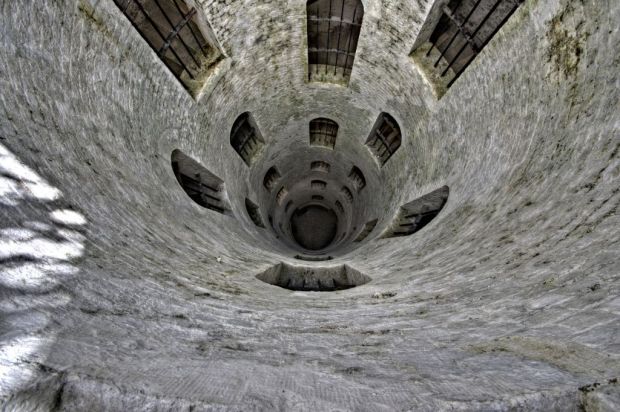
Photo courtesy of Heritage Open Days
The History
The Dover’s Grand Shaft was made by General Twiss, a military engineer. It was constructed in the 1st decade of the nineteenth century. This structure takes the system of a tripe helix staircase, offering 3 sets of steps in similar shaft with a principal light well. It has a 140-feet deep shaft that caters pedestrian access to the fortress, especially the Grand Shaft Barracks, from the street of Snargate at the end of the cliffs. There is a tunnel that leads from the base of the shaft to a security room. The 3 sets of stairs confined in the shaft, according to research, are committed for Offices and their wives or ladies, soldiers and their girls and Sargent’s and their partners, but the main reason is to deploy lots of troops in time of an invasion. The barracks were demolished in year 1960 and the channel fell into a tumble-down state. In year 1990, the channel was restored, with new guard spaces built at the base.
Drop Redoubt
This is one of the two fortresses on Dover Grand Shaft and is associated with the Citadel by a sequence of lines or dry moats. Arguably, it is the most striking and immediately evident feature of this structure.
The weaponry at this fort faced generally inland. This is because it was planned to bout an invading force trying to invade Dover at the back. The creation of this fort was in 2 periods – from year 1804 to tear 1808 and from year 1859 to 1864.
Armaments
Initially, the fort of Redoubt was to be armed with twelve smooth bore twenty-four pounder firearms and 2 carronades. On the other hand, it is not likely that a lot were setup since the Napoleonic war was virtually done by the time the construction was finished. In year 1851, just 3 of 24 pounders were setup, 8’ mortar and 12-pounde saluting firearms.
Following the 2nd period, 11 Armstrong 64-pounders rifled were setup on crossing carriages.
Redec Conservation Works
Redec was employed to undertake full repairs to the interior of the shaft and stairs, including: installing a full birdcage scaffold that had 8 platforms along he shaft, rewiring the consumer unit and installing an updated lighting system, lime repairs and limewash decoration throughout.
Today
At this point in time, the place is open for everyone. The barracks are demolished and the Citadel is now turned into Dover Immigration Removal Centre.
The Grand Shaft curved staircase is under the control of the council and is opened yearly by the WHPS or Western Heights Preservation Society.
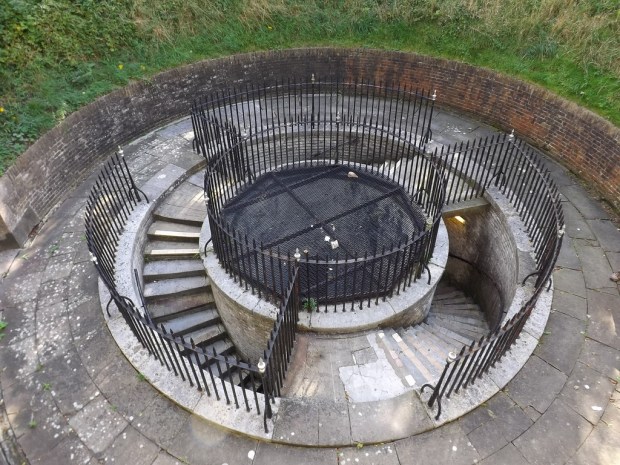
Photo courtesy of derelictplaces.co.uk
Even though it is preserved by Dover Council, the Dover Grand Shaft remains under the supervision of WPHS, which opens it to the public during specially organised heritage days. On the other hand, the barracks are open every day and you can visit the site anytime you want (these are operated by English Heritage).
A blog by marketing assistant Jen
 Conserving, Restoring, Refurbishing & Redecorating
great to see progress being made with this. It was in a sad state when I last saw it in 2014 when the Land Trust acquired Fort Burgoyne.
LikeLike
Thanks Euan, hope you and Alastair are both well.
LikeLike
which Alastair? who is Christopher Rip?
LikeLike