Photo courtesy of The National Trust
Located on the South Foreland in St. Margaret’s Bay, Dover, the South Foreland Lighthouse stands serene talking of the great Victorian Age that has lived by. It was used for warning ships that approached the Goodwin Sands nearby and earlier managed by the Knott family. Currently the lighthouse is under the care of National Trust after it went out of service in the year 1988.
In 1859, South Foreland Lighthouse became the first lighthouse to be run with the help of electricity. With advancement in technology by the year 1875, the lighthouse was able to use lamps made of carbon arc. It is a famous site in England for it has seen several scientific breakthroughs including the famous Guglielmo Marconi wireless experiments.
The lighthouse received the first ship to shore transmission through radio which was sent as a test message from the East Goodwin lightship and the first ship to shore signal of distress. South Foreland Lighthouse was also the first to receive an international radio transmission and it occurred when a signal arrived from Wimereux, in France in the year 1899.
There was another lighthouse originally further down the edge of the cliff to provide bearing on the leading lights. Both the lighthouses were built in the 1840s but the bearing became inaccurate since the Sands shifted as time passed. The lower light had to be taken out of service in the year 1910. Though the lighthouse remains as a part of the private garden, it is under constant threat from cliff erosion.
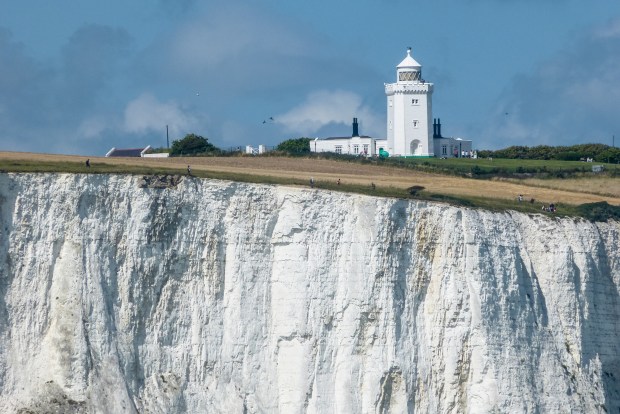
Photo Courtesy of Wiki
It is not certain as to why both the lighthouses were constructed. It is argued the leading lights theory is not convincing as it would not lead a ship to safe passage by turning to port upon lining up the two lights unless the navigator accurately knows how far the ship was from land. Another argument which is considerably stronger says that the ships approaching from the north may line up the lights to know when it was safe to turn in for the Dover Harbor. Still, all the arguments including many others remain uncertain.
The lighthouse marks the advancement of technology during the Victorian era and also serves as a milestone to mark the breakthrough of many scientific discoveries. Visitors can reach the lighthouse by walking through a footpath for one mile from St. Margaret’s village. It also has an optional path which is an approximately fifty minute walk from the White Cliffs Visitor Center. Many take the latter option as it takes you along the crest of the popular White Cliffs of Dover. Upon arrival, there is the main shaft to explore with views of France (on a good day!), a holiday cottage, a tea shop and gift shop.
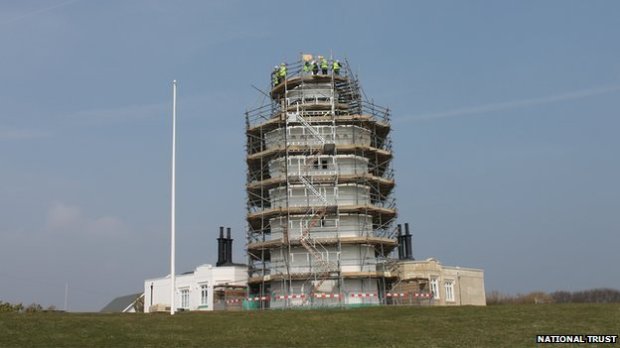
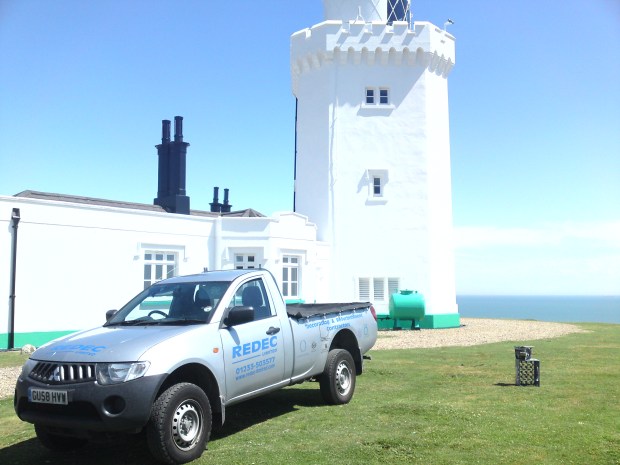
Redec was employed by the Trust to undertake a full conservation refurbishment and redecoration, this included: fully designed scaffolding, brickworks, lime render repairs, chimney pot repairs, removal of decayed paints, window repairs, general making good, new lightening protection, roof members, glazing, fencing and joinery repairs.
A blog by marketing assistant Jen.
 Conserving, Restoring, Refurbishing & Redecorating